Neville Middleton is a bloke who works in a mattress factory in Sydney’s southwest, yet his grey-bearded, bald-headed noggin appears on glowing billboards across multiple lux shopping centres in China: “From Australia – since 1899”.
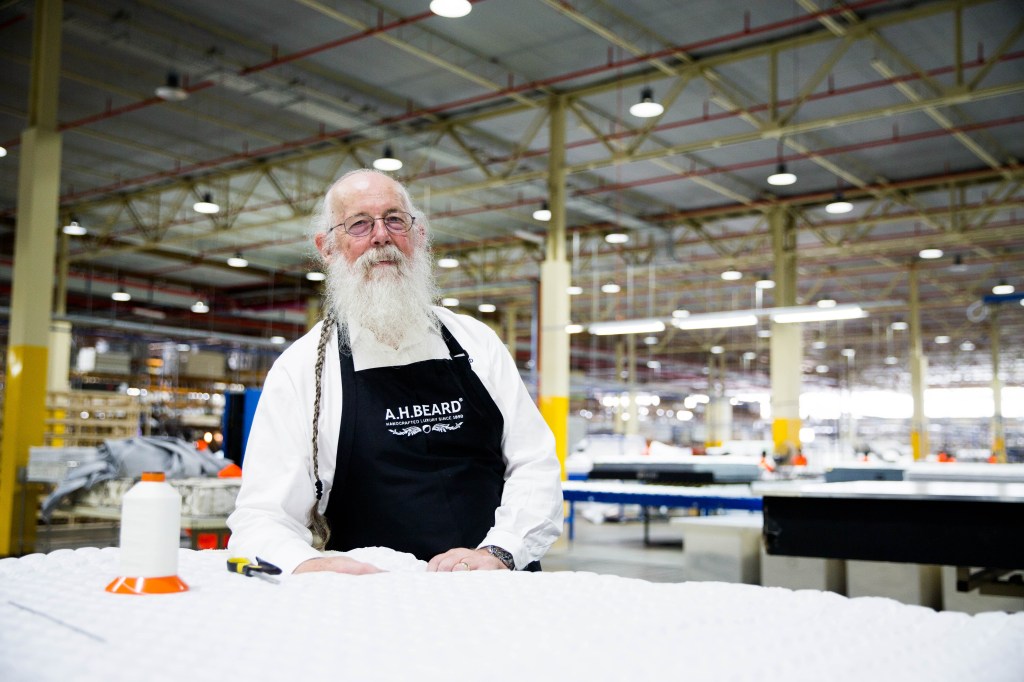
Middleton, not quite that old, is the “sleepsmith” in charge of building AH Beard mattresses that sell for up to $90,000 in China. And if you think that’s a lot for a mattress, the next generation of AH Beard Signature Heritage range launching later this year will be selling for between $120,000 and $150,000.
The 124-year-old family company has come a long way since the depths of the Global Financial Crisis when its very existence was under threat from an onslaught of cheap Chinese imports.
The Beard family went on a three-day retreat with key staff to figure out what their future held … If they even had a future.
Now the company is exporting about 2,000 mattresses a month, of which 8% are that high-end Signature brand, claiming to have increased exports by 221% over three years and contributing to the company’s more than $150 million revenue.
The $90,000 sleep
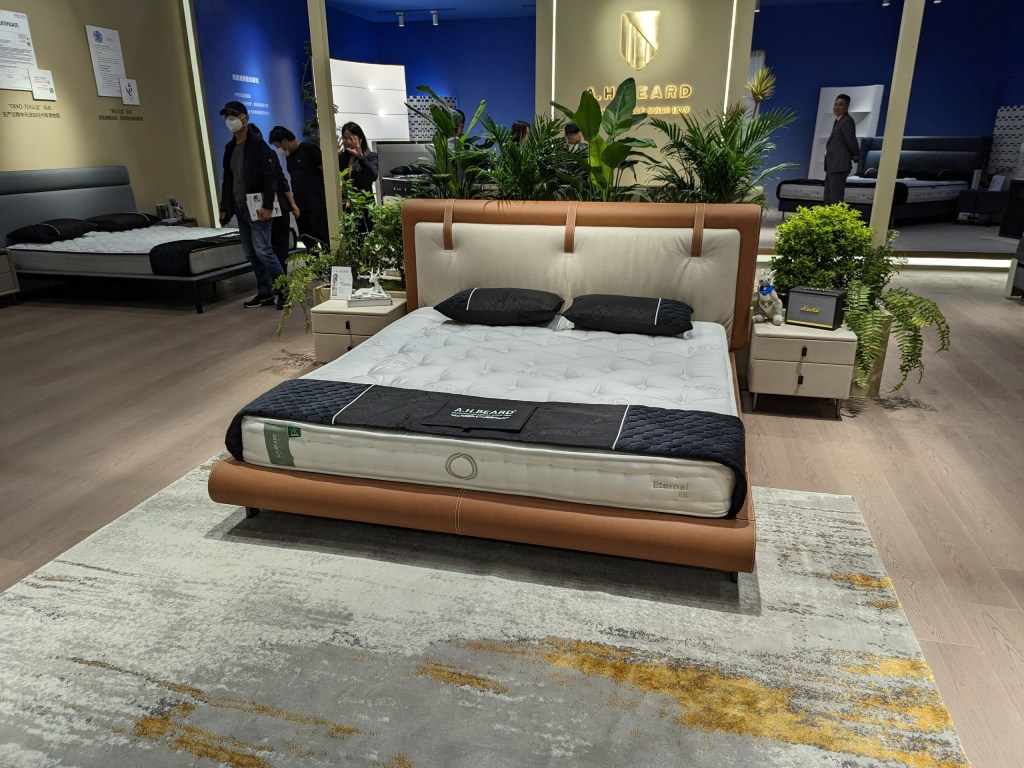
When customers walk into an AH Beard shop in China the process starts with them spending a lot of time lying on beds. A curtain will be pulled around the bed and the lights dimmed for the couple to have the full experience. And they’ll see a sleep expert. “They’ll sit down for hours and talk through the whole experience,” explains Middleton. “They’re spending a lot of money on these so they need to know.”
Founded in 1899 by Scottish immigrant Enoch Beard who made mattresses from straw and horsehair, AH Beard was being run by third-generation Austin Beard in the 1980s when he let his two sons, Garry and Allyn, run it while he went on a long trip to Cape York in North Queensland. “He came back and threw the keys on the table, ‘Mate, I’m retiring to Budderim,’” recalls Garry, now company chairman and managing director.
At that point, the business comprised one factory at Riverwood in Sydney’s southwest. They’d had a long relationship with retailer Gerry Harvey, so as his Harvey Norman shops expanded rapidly, they went with him. The brothers found themselves buying up old family mattress businesses just like theirs … but where the next generation wasn’t interested in taking over.
They soon had factories in every state, plus New Zealand.
Previously, bed makers manufactured under contract for the large department stores which tended to put their own brands on the products. While continuing to do that, the brothers started producing mattresses under an AH Beard brand, with all the complications that creating a brand entails.
In 2000, their biggest purchase yet was Domino Mattresses, another 100-year-old company. “Lo and behold, bringing two 100-year-old businesses together – the cultures – went outside the skills of my brother and myself,” recalls Garry. “We were too close to our people. I think that’s usually a huge advantage, but we had to decide who was going to stay and who was going to go.”
For the first time in the company’s history, they brought in an outsider, Peter Hunt, to run AH Beard. “It was the start of our professionalising of the business,” says Garry.
A new CEO, Paul Longman was at the helm when the cheap Chinese imports started giving them nightmares during the GFC.
Longman got all four Beard family shareholders and key employees on the three-day retreat to discuss what they were going to do about it. Should they compete on price? Should they move manufacturing to Asia? Should they go for the top end of the market?
They’d already tried the high-volume-low-cost route when their dad was running the show, recalls Garry. “At one stage we were the number-one unit producer in New South Wales. We made a lot of beds but very little money. That is a very tough game.” They didn’t want to shift manufacturing overseas. So they felt they had no choice but to go premium.
The first step was to upskill the workforce. The next was to spend $250,000 building a better website. “Thank god we did,” says current CEO Tony Pearson, who was then consulting to the business.
Because one day in 2012, three Chinese women – Emma Wang, Eva Lu, and Nicole Xie – knocked on the door without so much as a phone call’s warning. They asked to meet the bosses. The three women were all former nurses who had risen the wave of new Chinese affluence independently making small fortunes through Amway, bathroom renovations, and flooring. They thought the next big thing in China was going to be western-style bedding and so they’d teamed up to get into it with their business Shanghai Green.
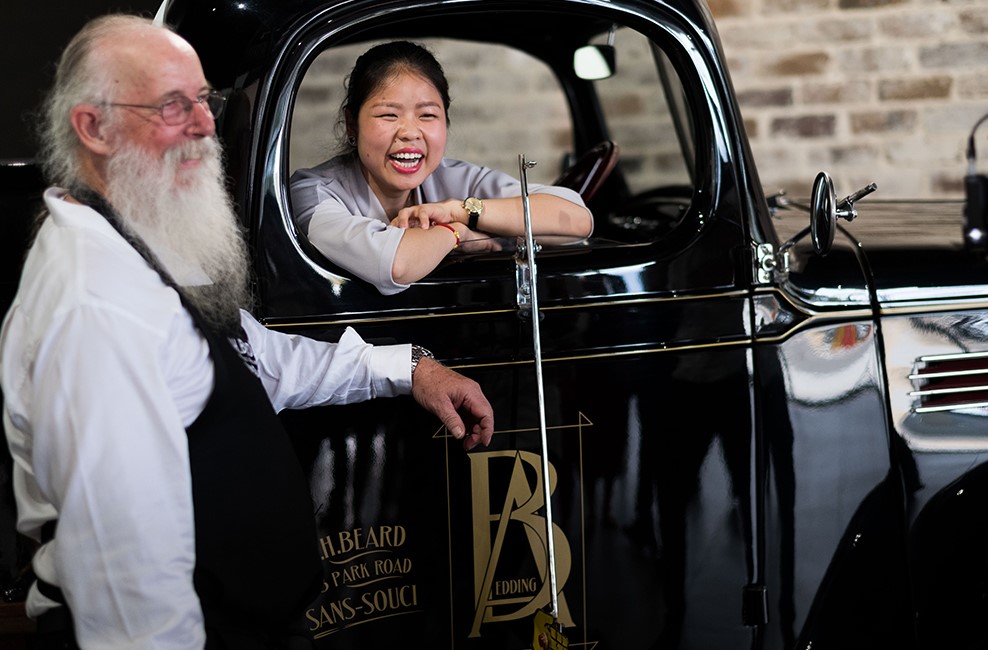
“When they said, ‘What is the best bed you can make that wholesales for $10,000 and retails for $70,000?’ it blew myself and my brother away,” recalls Garry. “And it certainly would have blown my father away.”
They formed a partnership. Former Australian prime minister John Howard opened the first AH Beard-branded shop in China in 2013. “I could not believe the crowds that we had,” says Garry. “It opened up our eyes to what was out there and what could be done.”
Within seven years they had expanded to 54 AH Beard stores in China. During COVID-19, that fell to 38, more from a shrinking economy than anti-Australian sentiment, says Garry.
Mattresses were not singled out by Chinese authorities like Australian wine and lobsters, though there were local examples of hostility like the time a front-page story appeared in a coal-mining town about Australia buying nuclear submarines to counter China, prompting sales there to dry up.
“Across the board, the second-tier cities did suffer more than what the first-tier cities did,” Garry says. “But they have started to come back again.” He expects they will soon be back over 50 stores again. And that’s not counting the 26 stores in Hong Kong where sales barely slowed at all.
What goes into a $90,000 mattress
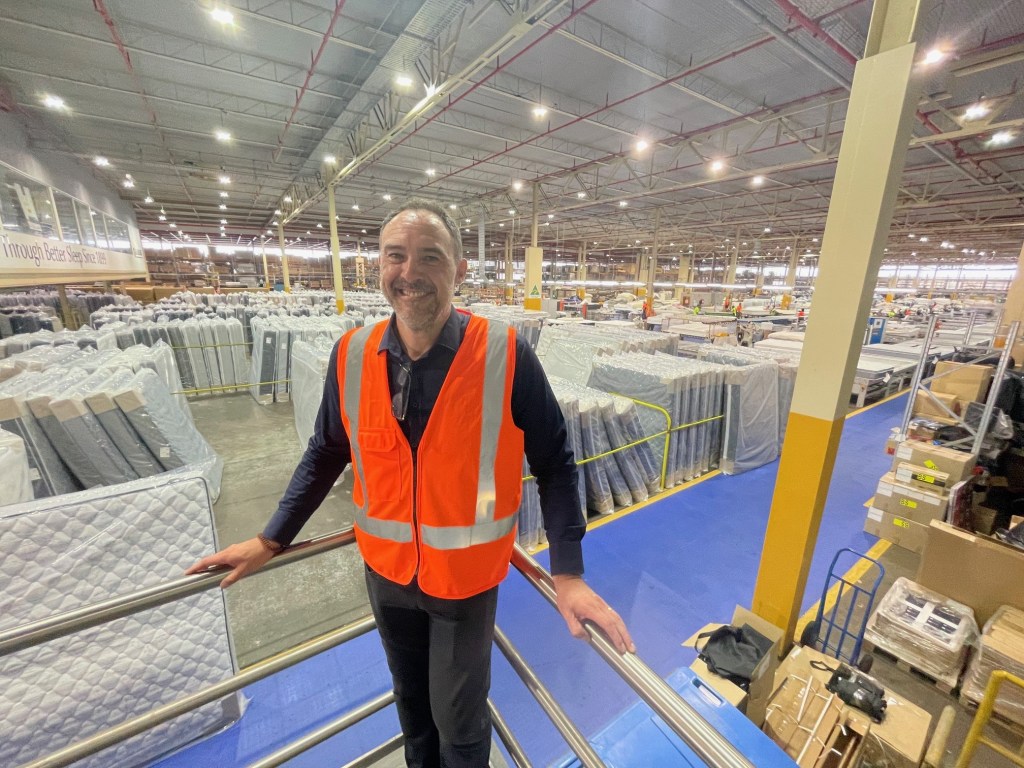
While AH Beard’s logistics are set up for 3-day, just-in-time supply to Australian retailers, the Signature mattresses going to China takes a lot longer. “There’s only six master craftsmen who we let touch that product because everything is handmade,” says Pearson.
Middleton demonstrates the complexity of putting a mattress together by hand, from the five layers of hand stitching around the sides – one worker making their way around the mattress five times with one needle – to all the bits that go in. There are springs, plus 21,000 mini coils – about the size of a 2-cm-deep $1 coin – that provide the bounce.
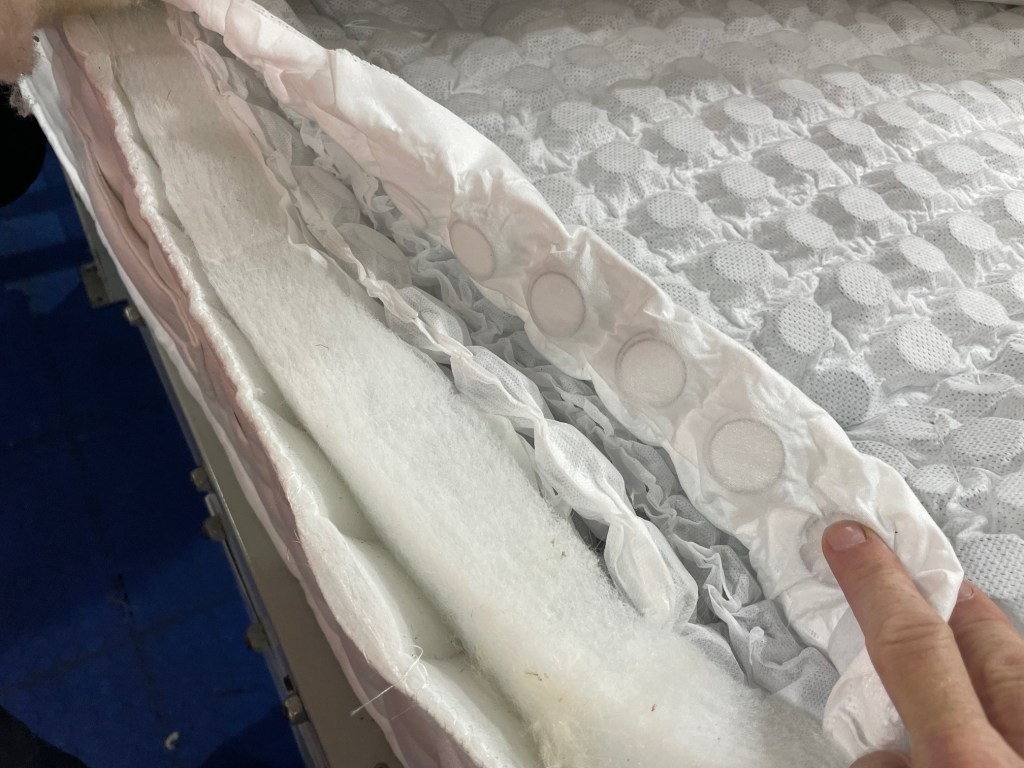
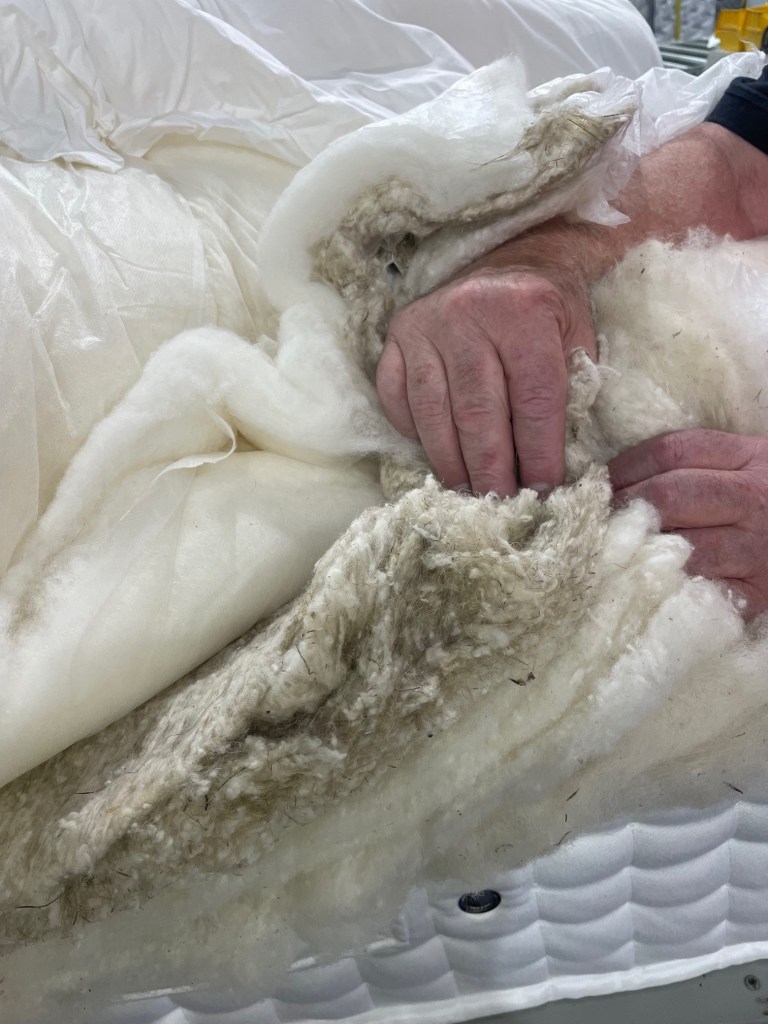
They are under layers of Australian wool, a wool cotton blend, another cotton pad, then more plain wool and merino wool [or Alpaca and cashmere] over the top.
“Everything here works towards keeping your body temperature at the right spot and also wicking away moisture – bringing it out of the bed,” says Middleton.
It takes seven to ten days to build one, then four weeks on a ship to China.
Middleton says they make about two of these $90,000 mattresses a week and five or six a week of the next level down.
Overall, the company exports 2,000 mattresses a month, Pearson says, of which 8% are the high-end Signature brand which range in price from $5,000 to $90,000.
And yes, Australians do buy some. At Gerry Harvey’s Domayne where they sell for just $30,000. They also sell some in the US but those are manufactured through a licensing partner in Norfolk, Virginia.
The new range of mattresses being launched later this year will go for up to $150,000. “It’s been 12 to 18 months of R&D, and the largest part of that was talking to end users in that [high-end] segment, as well as their influencers, architects, designers, luxury retailers,” says Pearson.
One of the innovations in the new bed will be the use of the eucalyptus-tree derived Tencel, Garry Beard says. “It’s a thread that’s made from a tree. It’s the dearest thread we can use in a mattress fabric. It’s not available in the rest of the world. We were able to find a weaver who was able to make it for us.” Its greatest advantage over other fabrics is heat dissipation, he says. “But the feel is silky, and it’s unique in that the type of weaving required is done by one of the best weavers in the world.”
The company is also introducing sleep tracking technology as both an add-on and a built-in. “We’re starting to see very good AI products coming to market,” says Pearson. “The moment you lay on the product, the bed will start analysing you. It’s analysing the amount of pressure that’s being experienced by you and the bed. It will be reading sleep-tracking data – so heart rates, breathing rates, tossing and turning – and be able to work out where you are in the sleep cycle.
“What’s really exciting though is what the bed can do in response. The bed will learn how to modify the degree of support and pressure-relieving comfort that you need in different areas of the bed and continue to adapt over the course of the night and over multiple nights … It’s learning you over time.”
Knowledge is oxygen
Pearson, who took over as CEO in 2016, subscribes to the ideas of Melbourne social scientist and corporate advisor Dr Ross Honeywill, who specialises in high-value customers that he styles as “New Economic Order” consumers, or “NEOs”.
“One of the things emblematic of a NEO buyer is that knowledge is oxygen,” says Pearson. “They’re looking for insight. It’s as much about your product as it is about your ability to talk about your product and ethics and approach to running your business.
“They don’t want to be shouted at. You need to be able to articulate all your whys. ‘Why did we use wool? Why did we use wool with flax through it? Why did we use Tencel? Why did we tuft it instead of using glue?’
“We’re in the sleep industry and the sleep industry sits withing the wellness industry … Sleep is the first pillar of health. There are things that can only happen for the body when you’re in an effective sleep state. Your mind is regenerating, you’re laying down memories, you’re clearing out the junk.”
A fifth-generation member of the Beard family, Rachel Beard, has taken on the role of raising awareness of the importance of sleep for health, launching the company’s Sleep Wellness Centre in 2022.
Taking on the world
When the Shanghai Green team visited again in late 2023, they outlined plans to have 100 stores open in China by 2028, Pearson says.
“We now have three partners across China with different brands and products. Hong Kong has been our fastest growing export market. We have partners in South Korea, Thailand, PNG, and a trademark relationship for manufacturing in Fiji under our brand licence; a major AH Beard trademark and manufacturing deal in the US; and (in September) we launched the first trademark co-operation with the Brazilian market.”
AH Beard employs 430 staff across its six state capital factories, plus 35 people at its Auckland plant. “We are the second largest bedding manufacturer in Australia (behind Seely), but second by choice because we are not a lower-cost mass distributed product,” says Pearson.
Keeping it in the family
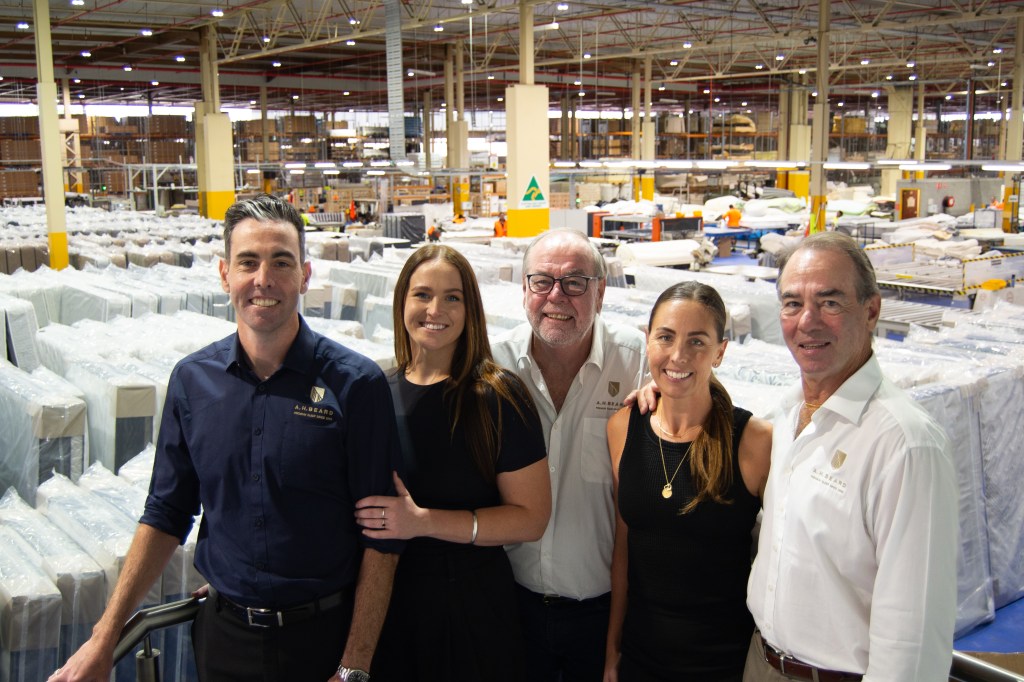
The business will turn 125 in November. But the family has a stated intention to get to 200 years of continuous ownership across ten generations. The business was almost destroyed when Austin’s siblings demanded to be paid out a generation ago. It narrowly survived but Garry Beard says they remain acutely aware of the importance of bringing all shareholding family members along for the ride.
Every year, all the sibling owners go to the Family Business Australia conference, he says. “They get to hear the war stories, the good and the bad, from family businesses across Australia – the Coopers (brewing), the Taylors (winemaking), the Smorgons (diversified). The learning I got from 25-years’ involvement in that is that it’s not the business destroying the family, it’s the family destroying the business.
“A concerted effort has to be made to communicate. So we meet quarterly as shareholders. We give them (the siblings) the numbers the board gets. We’re embarking on the first part of the transition where my son is an observer on the board. My sister’s daughter, Haley, is also on the board.
“So we’re starting to bring the next generation through to understand how the business operates and how we move forward as a family.”